Ever feel like you’re arguing with a robot? You ask for a blog post and get a robotic, generic mess. You ask for a creative hook and get a dictionary definition. It’s like asking an intern to “make the website better” and coming back to find they just changed the button color .
The problem isn’t that the AI is “bad”—it’s that your instructions are lacking .
Prompt engineering is the practice of designing and refining inputs (prompts) to get the most accurate, relevant, and useful responses from AI language models.
Think of it as learning to speak the AI’s language effectively. It’s the art of asking the right questions in the right way to get the best possible answers.
Technically, prompt engineering is the process of structuring text inputs to guide large language models toward generating specific outputs. It involves understanding model architectures, token limitations, context windows, and fine-tuning instructions to optimize performance for specific tasks.
Real-World Explanation
Imagine walking into a restaurant and saying, “Give me food.” The server might bring you anything – soup, salad, steak, or dessert. You’d likely be unsatisfied with the random result.
Now imagine saying, “I’d like a medium-rare ribeye steak with garlic mashed potatoes and grilled asparagus.” The server knows exactly what you want and delivers precisely that.
Prompt engineering works the same way. Vague inputs yield vague (or incorrect) outputs. Specific, well-structured prompts yield exactly what you need.
Easy Analogy
Think of prompt engineering like being a movie director. The AI is your talented actor. You can say, “Act sad,” and you might get an okay performance. But if you say, “You’re a grieving father at your daughter’s wedding, trying to hold back tears while giving a toast,” your actor delivers an Oscar-worthy performance.
Why Prompt Engineering Matters
1. Better AI Responses
When you craft precise prompts, you get responses that directly address your needs. Instead of generic, shallow answers, you receive detailed, nuanced, and actionable outputs.
2. Saves Time
One well-crafted prompt can save you hours of back-and-forth with the AI. You get it right the first time instead of iterating endlessly.
3. Improves Accuracy
Specific prompts lead to specific, accurate responses. When you tell the AI exactly what you need, it doesn’t have to guess – and guessing often leads to errors.
4. Reduces Hallucinations
AI “hallucinations” occur when models generate plausible-sounding but completely false information. Good prompt engineering dramatically reduces this risk by providing clear context and boundaries.
5. Higher Productivity
When you master prompt engineering, you can automate research, create content faster, solve problems more efficiently, and make better decisions.
Understanding Generative AI
Before diving deeper into prompt engineering, let’s clarify the foundational technologies:
AI (Artificial Intelligence): The broad field of creating machines that can perform tasks requiring human intelligence.
Machine Learning: A subset of AI where systems learn from data without being explicitly programmed. Instead of following rigid rules, ML models identify patterns.
Deep Learning: A specialized form of machine learning using neural networks with multiple layers (hence “deep”). These networks process information similarly to the human brain.
Generative AI: The specific branch of AI that creates new content – text, images, audio, video, or code. Unlike traditional AI that classifies or predicts, generative AI produces original material.
Foundation Models: Large-scale AI models trained on enormous datasets that can be adapted for various tasks. Think of them as the engine driving the AI car.
What Are Large Language Models (LLMs)?
LLMs are the engines behind tools like ChatGPT. Here’s what makes them work:
1. Tokens
Tokens are the basic units of text that AI processes. They can be words, parts of words, or punctuation. The AI breaks your prompt into tokens and processes them sequentially. Different models have different token allowances.
2. Context Window
This is the amount of text the AI can “remember” while generating a response. Think of it as the AI’s short-term memory. Some models can handle 8,000 tokens (about 6,000 words), while newer models handle 100,000+ tokens.
3. Transformer
The transformer is the neural network architecture powering modern LLMs. It’s the breakthrough that made models like ChatGPT possible. Transformers process all input tokens simultaneously rather than sequentially, enabling parallel processing and better understanding of context.
4. Training Data
LLMs are trained on massive datasets – essentially everything available on the internet up to their training cutoff date. This includes books, articles, websites, code, and more. The model learns patterns, relationships, and knowledge from this data.
5. Examples of LLM Training
- GPT models trained on billions of web pages
- Claude trained on a combination of publicly available data and curated content
- Llama trained on open-source web content and books
Popular LLMs
1. ChatGPT (OpenAI)
The most widely known LLM. Available in various versions (GPT-3.5, GPT-4, etc.), each with different capabilities and context windows.
2. Claude (Anthropic)
Known for excellent reasoning and safety features. Particularly strong for complex analysis and longer-form content.
3. Gemini (Google)
Google’s flagship model with multimodal capabilities – can process text, images, audio, and video.
4. DeepSeek
A powerful open-source model from China. Competitive with major proprietary models at lower cost.
5. Llama (Meta)
Meta’s open-source LLM family. Widely used for research and private deployments due to its availability.
6. Mistral
A European open-source model known for efficiency and strong performance relative to its size.
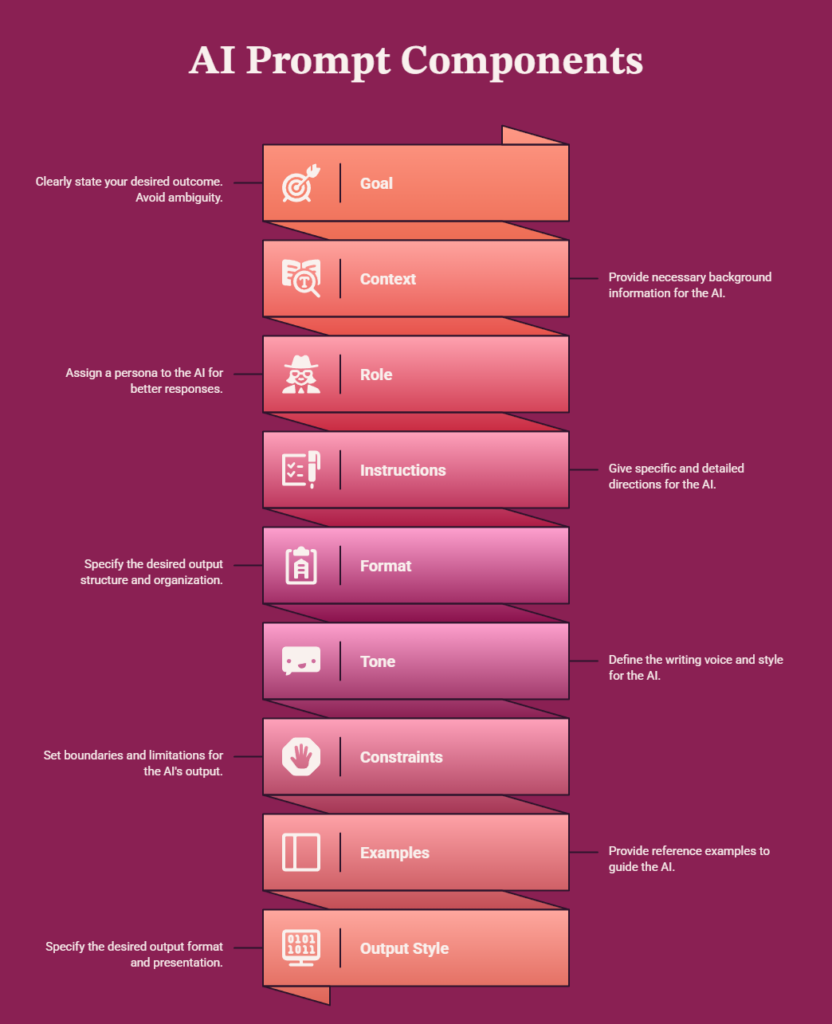
Components of a Great AI Prompt
Let’s break down the essential elements:
1. Goal
State exactly what you want. Don’t make the AI guess.
Example: “Write a 500-word blog post about the benefits of remote work for employee productivity.”
2. Context
Provide relevant background information.
Example: “The target audience is HR managers at mid-sized companies. The tone should be professional yet accessible.”
3. Role
Assign a persona to the AI.
Example: “You are an experienced HR consultant with 15 years of experience.”
4. Instructions
Specific, detailed directions.
Example: “Include three concrete benefits with supporting evidence. Mention potential counterarguments and address them.”
5. Format
Specify the output structure.
Example: “Use subheadings. Include bullet points for key benefits. End with a conclusion that summarizes main points.”
6. Tone
Define the writing voice.
Example: “Professional but conversational. Use second-person (you). Avoid jargon.”
7. Constraints
Set boundaries.
Example: “Limit to 500 words. Focus on research-backed benefits only. Avoid generic statements.”
8. Examples
Provide reference examples of what you want.
Example: “Here’s an example of a benefit paragraph: ‘Remote workers report 22% higher satisfaction rates…'”
9. Output Style
Specify the desired output format.
Example: “Generate HTML with proper heading tags. Include meta description suggestions.”
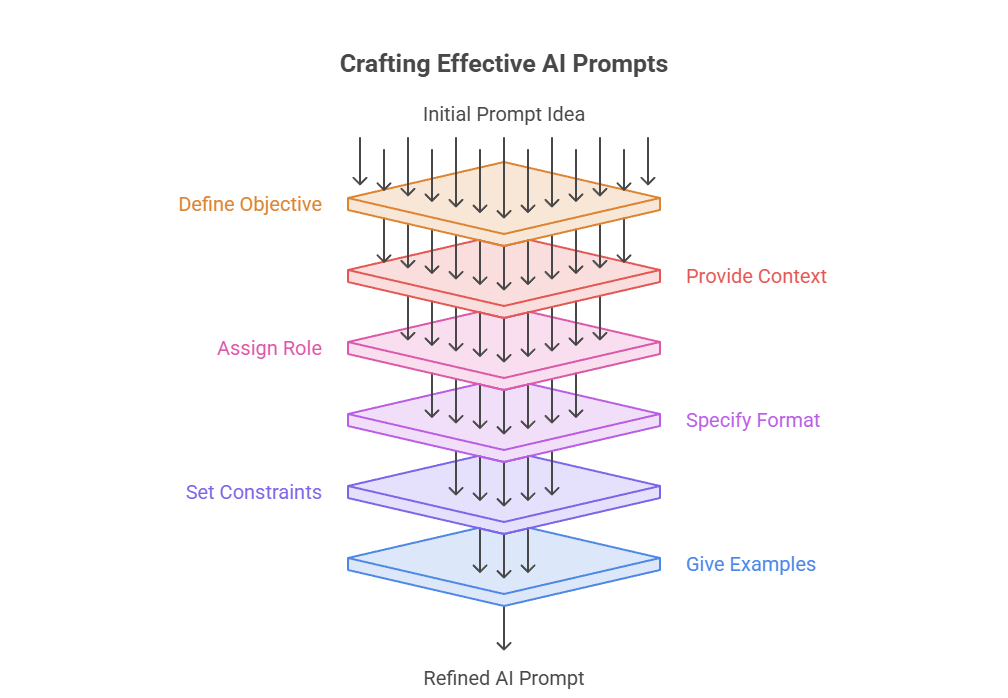
How to Write Better AI Prompts
Step 1: Know Your Objective
Clarify what you want before you start writing. Be specific about your desired outcome.
Step 2: Give Context
The AI isn’t a mind reader. Provide background information, audience details, and any relevant constraints.
Step 3: Assign a Role
Telling the AI to act as an expert in a specific field often produces better, more focused results.
Step 4: Specify Output Format
Tell the AI exactly how you want the response structured.
Step 5: Set Constraints
Provide length limits, topics to cover, and topics to avoid.
Step 6: Provide Examples
When possible, show the AI what “good” looks like. Examples dramatically improve output quality.
Step 7: Iterate and Improve
Treat prompting as a dialogue, not a one-time interaction. Refine your prompts based on the responses you receive.
The 3 Pillars of a High-Performing Prompt
Instead of a boring definition, let’s use a formula. The most effective prompts follow a simple structure of 3 key components:
Role: Who is the AI acting as? This sets the tone, expertise, and voice. Instead of “You are an AI,” you say, “You are an SEO strategist with 10 years of experience” or “You are a witty, irreverent copywriter for a Gen-Z brand” .
Task: What do you want, specifically? This is where you get granular. “Write 10 headlines” is okay. “Write 10 headlines under 60 characters for a finance blog, each using a different power word like ‘Crush,’ ‘Maximize,’ or ‘Avoid'” is better.
Context: What does the AI need to know about your audience? This is the secret sauce. “Write for busy CMOs who don’t have time for fluff” or “Write for beginner gardeners looking for simple, step-by-step instructions” .
Basic Prompt Structure
A well-structured prompt typically follows this template:
[Role]
You are a [professional title] with [years] of experience in [field].

[Task]
Your task is to [action verb] a [content type] about [topic].

[Context]
The target audience is [audience], and they need [specific outcome]. The purpose is [goal].

[Requirements]
Include [specific elements]. Focus on [key points]. Avoid [things to exclude].

[Output Format]
Produce [format type] with [specific structure]. Use [style guidelines].
Example:
You are a seasoned digital marketing strategist with 10 years of experience in B2B SaaS.

Your task is to create a 7-day social media campaign outline for launching a project management tool designed for remote teams.

The target audience is operations managers at growing tech companies. They need practical tips they can implement immediately. The purpose is to educate, build trust, and drive free trial signups.

Include daily content themes, post formats (carousel, video, text), suggested headlines, and engagement hooks for each day. Focus on solving specific pain points like communication breakdowns and missed deadlines. Avoid generic advice.

Produce a table with Day, Theme, Content Type, Headline, and Engagement Hook columns. Keep each daily description to 50 words.